Maximum Leverage by Country and Regulator

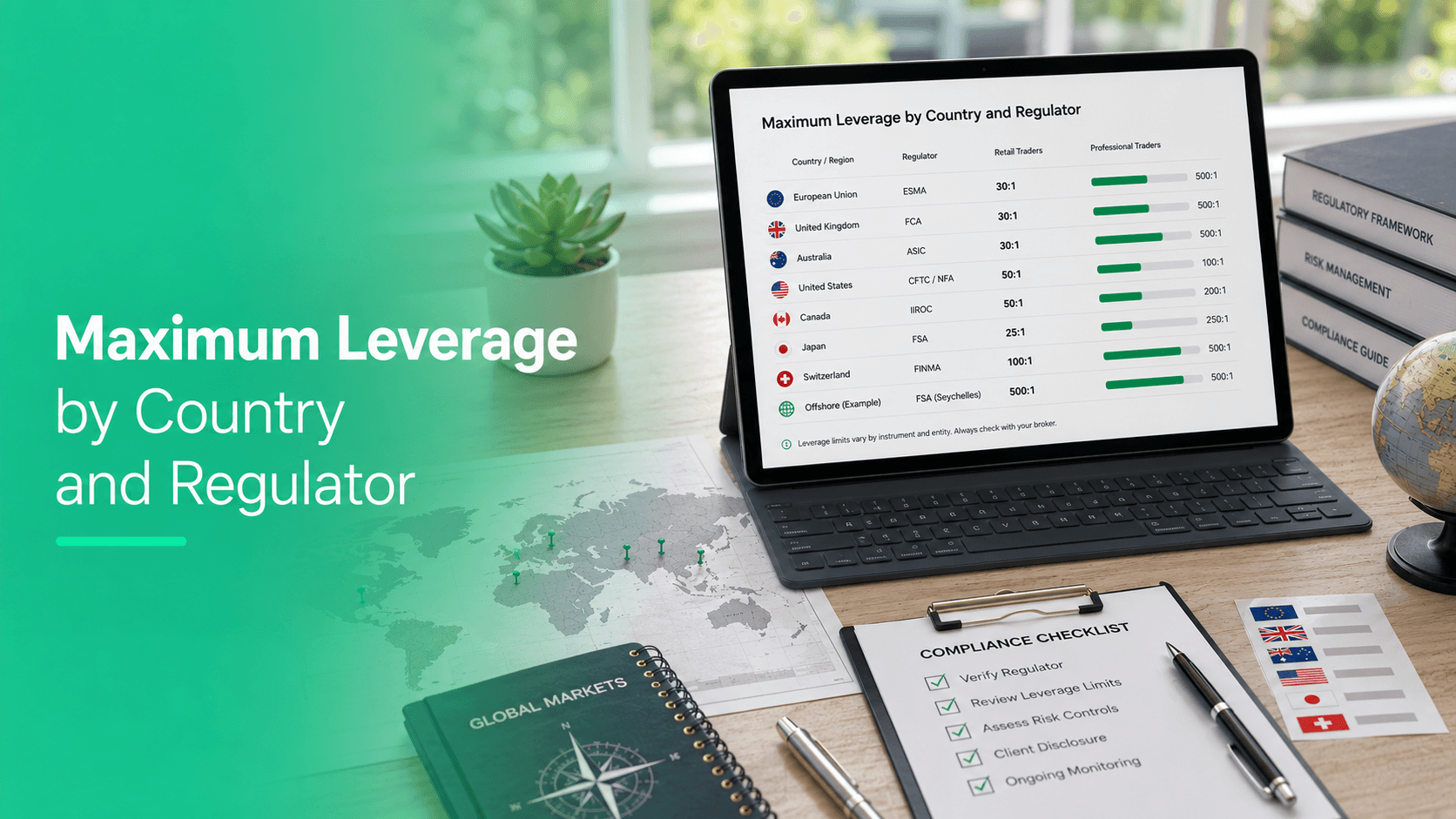
Retail leverage on major currency pairs is capped at 30:1 in the UK, the EU and Australia, and at 50:1 in the United States. Offshore jurisdictions apply no equivalent cap, which is why brokers licensed there advertise 500:1 and higher.
The number that applies to you is set by the entity that holds your account, not by the country you live in, and that catches out more traders than the caps themselves.
What Are the Actual Limits?
Every figure below comes from the regulator's own rules. Caps vary by asset, not just by country.
| Asset | UK (FCA) | EU (National Regulators) | Australia (ASIC) | US (CFTC/NFA) |
|---|---|---|---|---|
| Major currency pairs | 30:1 | 30:1 | 30:1 | 50:1 |
| Minor currency pairs | 20:1 | 20:1 | 20:1 | 20:1 |
| Gold | 20:1 | 20:1 | 20:1 | n/a |
| Major stock indices | 20:1 | 20:1 | 20:1 | n/a |
| Other commodities | 10:1 | 10:1 | 10:1 | n/a |
| Minor stock indices | 10:1 | 10:1 | 10:1 | n/a |
| Individual shares | 5:1 | 5:1 | 5:1 | n/a |
| Government bonds | 30:1 | 5:1 | 5:1 | n/a |
| Crypto | Banned for retail | 2:1 | 2:1 | n/a |
Three things about that table matter more than the numbers.
The UK and the EU Are Not Identical
When the FCA made the European rules permanent in 2019, it deliberately set one tier differently: CFDs on government bonds issued by the UK, the US, Japan, Canada, Switzerland or a euro-adopting EU state get 30:1 in the UK, against 5:1 under the European measures. Everything else matches.
The EU Column Is Not One Rule
The European caps are applied by each national regulator, so the figure for a Cyprus firm is set by CySEC and the figure for a German firm by BaFin. They mostly mirror each other.
Where two sets of rules could apply to the same trade, the stricter one wins, so a trader in a country with tighter limits does not get the looser cap by signing with a firm abroad.
The US Regulates Leverage Differently
The US column has gaps because the US regulates this differently. The CFTC sets a minimum security deposit rather than a leverage ratio: 2% of notional for major currencies, which works out at 50:1, and 5% for all other currencies, which is 20:1.
Retail CFDs on shares, indices and commodities are not offered to US retail clients the way they are elsewhere, so those rows do not exist. The NFA sets the specific deposit levels inside the CFTC's parameters and can set them tighter, and it also decides which currencies count as major.
Is a 30:1 Cap the Same Thing in London and Sydney?
No, and this is the detail almost every comparison table gets wrong.
Both the FCA and ASIC cap major currency pairs at 30:1. They disagree about what a major currency pair is. The FCA's list is the US dollar, euro, Japanese yen, pound sterling, Canadian dollar and Swiss franc. ASIC uses that same list plus the Australian dollar.
So AUD/USD is a major pair in Australia and gets 30:1. In the UK it is a minor pair and gets 20:1. Same headline cap, different exposure on the same trade, purely because of how each regulator drew up its list.
If you trade Australian dollar crosses, that difference is worth more to you than the headline number.
Why Does One Broker Offer Me 30:1 and Someone Else 500:1?
Because you are not dealing with the same company.
Large brokers run several licensed entities. The same brand might hold an FCA licence, an ASIC licence and a licence in Seychelles or Vanuatu. Which one onboards you depends on your country of residence and sometimes on which website you signed up through.
Your leverage cap, your negative balance protection and your compensation scheme all follow that entity, not the brand.
This is why two traders using what looks like the same broker can have completely different maximum leverage. Before depositing, check the entity name and licence on the broker's profile rather than the headline figure in the advertising.
That is what the regulation details on Pepperstone's broker profile or IC Markets Global's licensing and entity details are there for. Entity structure is one of the things worth working through when choosing a forex broker, and it often tracks the account tier you are offered, which is covered in how forex account types differ.
Caps are also ceilings, not entitlements. The FCA's rules let firms set lower leverage than the cap, and let them raise margin requirements on positions you already have open.
A broker can tighten your leverage before a volatile event and is only expected to give reasonable notice. Sizing a position on the assumption that today's leverage is permanent is how people get closed out.
What Does a Cap Actually Mean for the Money in Your Account?
It is a margin requirement written backwards.
The FCA does not write its rule as “30:1.” It writes it as a minimum margin of 3.33% of the exposure for major pairs, 5% for minor pairs, gold and major indices, 10% for other commodities and minor indices, and 20% for shares.
Divide 1 by the percentage and you get the ratio. A 3.33% margin requirement is approximately 30:1 leverage. A 5% margin requirement is 20:1 leverage.
Reading it as a percentage is more useful, because that is the number you actually fund. A 10,000 position on a major pair needs 333 in margin under a 30:1 cap. The same position at 500:1 offshore needs 20.
If margin and exposure are new to you, how CFD trading works covers the mechanics, and the amount you need before any of this is worth doing is set out in how much money you need to start trading.
What Do You Give Up to Get Higher Leverage?
The caps do not travel alone. In the UK, the EU and Australia they arrive bundled with two protections that matter more than the ratio.
The first is a standardised close-out. Your broker has to start closing positions once your account equity falls to 50% of the margin your open positions require.
The second is negative balance protection, which limits your losses to the money in the account, so a gap cannot leave you owing the broker.
Offshore licences generally require neither. That is the real trade when a broker offers you 500:1: you are not just buying a bigger position, you are giving up the circuit breaker and the floor under your losses.
The FCA said outright when it set these rules that some traders would move to firms in other jurisdictions to get higher leverage, and decided that weaker standards elsewhere did not justify weakening its own.
What Should You Check Before Assuming a Number Applies to You?
- The entity name on your account agreement and which regulator licenses it
- The cap for the specific instrument you trade, not just for major pairs
- Whether your pair counts as major or minor under that regulator's own list
- Whether the account has negative balance protection and a stated close-out level
- What the broker's terms say about changing leverage or margin on open positions
If the broker's advertised maximum is far above 30:1 and you live in the UK, the EU or Australia, that figure is not for you.
It belongs to an offshore entity, and either you will be onboarded to a locally licensed entity with the lower cap, or you are about to be onboarded somewhere with none of the protections you assumed you had.

Related Posts

CMC Funded Is Titanium Sponsor of London Prop Trading Expo
CMC Funded, the new simulated evaluation programme from CMC Markets, is Titanium Sponsor of the London Prop Trading Expo on 23 and 24 October 2026. The programme also named Verichain as its first referral partner, with a $100,000 simulated evaluation that leads to an interview.

FundedTrading Heads to London Prop Trading Expo 2026 as Official Media Partner
FundedTrading joins the London Prop Trading Expo 2026 as Official Media Partner, with on-site coverage October 23–24 and 50% off tickets using code FT50.