MetaTrader 4 vs MetaTrader 5: Which Should You Use?

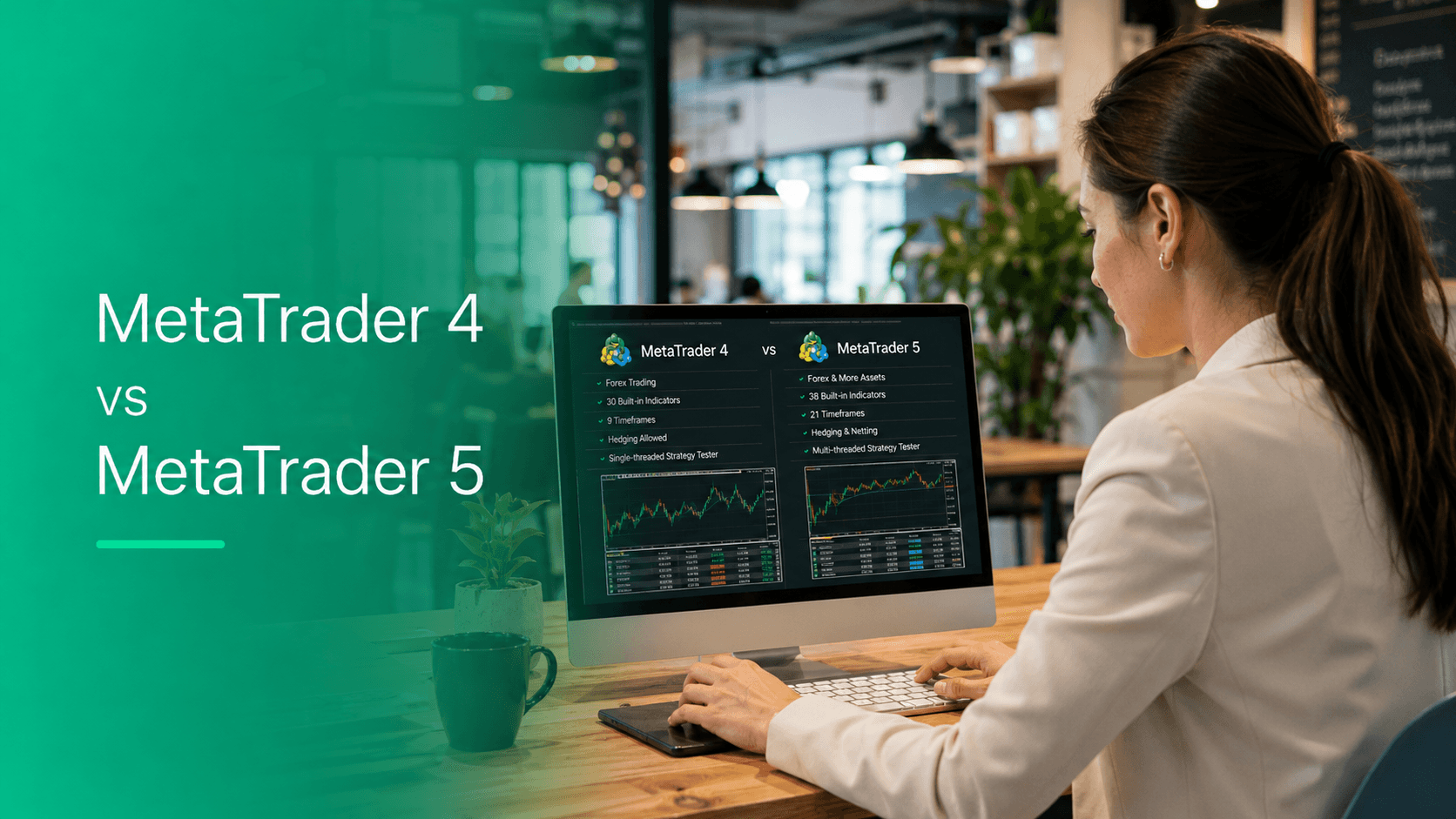
MetaTrader 4 and MetaTrader 5 are both widely used trading platforms, but they are not interchangeable. MT4 is still a practical choice for forex-focused traders who rely on a familiar interface, legacy Expert Advisors, and broad broker support. MT5 is the better long-term choice for traders who want more markets, more order types, deeper strategy testing, and a more modern multi-asset setup.
The short answer: choose MT4 if your broker, indicators, or automated strategies are built around it. Choose MT5 if you are starting fresh, want broader market access, or care about more advanced technical and backtesting tools.
Before choosing either platform, remember that MetaTrader is only the software layer. Your actual trading conditions still depend on the broker: regulation, execution quality, spreads, commissions, swap rates, available instruments, and account rules. If you are still comparing brokers, start with our guide on how to choose a forex broker.
Quick Verdict: MT4 vs MT5
| Category | MetaTrader 4 | MetaTrader 5 |
|---|---|---|
| Best for | Forex and CFD traders using legacy tools | Multi-asset traders and newer automated strategies |
| Market focus | Primarily forex | Forex, stocks, futures, options, and bonds, depending on broker |
| Timeframes | 9 | 21 |
| Built-in indicators | 30 | 38 |
| Graphical objects | 31 | 44 |
| Pending order types | 4 | 6 |
| Depth of Market | Limited or not core | Supported |
| Strategy tester | Single-threaded | Multi-threaded, multi-currency, and real ticks |
| Programming language | MQL4 | MQL5 |
| Learning curve | Easier for many forex traders | Slightly steeper but more capable |
MetaQuotes’ own MT4 vs MT5 comparison shows the main structural difference: MT5 has more order types, more timeframes, more indicators, Depth of Market, broader supported markets, and a more advanced strategy tester.
What Is MetaTrader 4?
MetaTrader 4, usually called MT4, is the older and still highly popular platform in the MetaTrader family. It was built around forex trading and remains widely used by retail forex and CFD traders.
According to the official MetaTrader 4 platform page, MT4 includes interactive charts, technical indicators, pending orders, one-click chart trading, alerts, financial news, mobile apps, and automated trading through Expert Advisors.
MT4’s strength is not that it is the newest platform. It is that the ecosystem is huge. Many traders still use MT4 because their broker supports it, their indicators are written for it, and their Expert Advisors were developed in MQL4.
What Is MetaTrader 5?
MetaTrader 5, or MT5, is the newer multi-asset platform. It was not simply designed as “MT4 with a new skin.” It was built with a broader market structure in mind.
The official MetaTrader 5 platform page describes MT5 as a platform for currencies, stocks, and futures. It supports Market Depth, hedging and netting position accounting, more order types, more timeframes, integrated fundamental tools, copy trading, automated trading, and web and mobile access.
For traders who want one platform for forex, indices, commodities, shares, futures, and other instruments offered by their broker, MT5 is usually the stronger choice.
Main Differences Between MT4 and MT5
1. Market Access
MT4 is most closely associated with forex and CFD trading. Many brokers also offer indices, metals, commodities, and crypto CFDs on MT4, but the platform’s original structure is forex-centered.
MT5 is more explicitly multi-asset. MetaQuotes lists MT5 support for forex, futures, options, stocks, and bonds, while MT4 is listed for forex in its official comparison. In practice, your actual market access depends on the broker. A broker can offer a limited MT5 product range, while another broker may offer a broad CFD or exchange-traded product list.
This is why platform choice should come after broker due diligence. For example, brokers such as IC Markets and FP Markets are often considered by traders who want access to MetaTrader platforms, but the right choice depends on regulation, fees, instruments, and account type.
2. Order Types and Execution Tools
MT4 gives most retail forex traders the basics: market orders, four pending order types, stop loss, take profit, and trailing stop.
MT5 adds more flexibility. MetaQuotes lists six pending order types for MT5 compared with four for MT4. MT5 also supports Market Depth and exchange-style data tools where the broker or market connection provides them.
This matters for traders who use more precise order placement, trade instruments with order book visibility, or want a platform that can better support exchange-style execution. For simple forex swing trading, MT4’s order tools may be enough. For multi-asset and more active trading, MT5 has the edge.
3. Charts, Indicators, and Timeframes
Both platforms are strong for technical analysis, but MT5 provides more built-in depth.
MT4 includes 9 timeframes, 30 technical indicators, and 31 graphical objects. MT5 expands this to 21 timeframes, 38 technical indicators, and 44 graphical objects, according to MetaQuotes’ comparison.
That does not automatically make MT5 better for every trader. Many MT4 users already rely on custom indicators, templates, and chart setups that cover their needs. But if you are starting from zero, MT5 gives you more flexibility out of the box.
4. Automated Trading: MQL4 vs MQL5
Both MT4 and MT5 support automated trading through Expert Advisors, custom indicators, scripts, and strategy tools.
MT4 uses MQL4. The official MQL4 documentation describes it as a language for programming trading strategies and creating Expert Advisors and custom indicators.
MT5 uses MQL5. The official MQL5 documentation describes a broader development environment with standard library classes and tools for more advanced trading applications.
The key practical point: MT4 Expert Advisors and indicators do not simply transfer to MT5 without work. If you already depend on a profitable or operationally important MT4 EA, switching platforms can mean rewriting, retesting, and revalidating the strategy.
For discretionary traders, this may not matter much. For automated traders, it can be the deciding factor.
5. Strategy Testing and Optimization
This is one of MT5’s clearest advantages.
MT4’s strategy tester is useful for basic single-symbol backtesting, but MT5 offers a more advanced tester. MetaQuotes lists MT5’s strategy tester as multi-threaded, multi-currency, and real-tick capable, while MT4’s is single-threaded.
For traders who optimize Expert Advisors, test portfolio-style strategies, or care about more realistic historical simulations, MT5 is better equipped. Backtesting still has limits, of course. Historical performance does not guarantee future results, and poor-quality data or over-optimization can make any platform look better than reality.
6. Hedging and Netting
MT4 is known for hedging-style trading, where multiple positions can be opened on the same instrument.
MT5 supports both hedging and netting, according to MetaQuotes. Hedging is common in retail forex. Netting is more common in exchange-traded markets, where multiple trades in the same instrument are consolidated into one net position.
This makes MT5 more adaptable across asset classes. It also means traders should check how their broker configures MT5 accounts. Two brokers can both offer MT5 but apply different account settings, margin rules, or execution models.
Is MT5 Better Than MT4?
MT5 is technically more advanced than MT4. It has more timeframes, more order types, more built-in indicators, broader market support, Depth of Market, and stronger strategy testing.
But “more advanced” does not always mean “better for you.”
MT4 can still be better if:
- Your broker’s best trading conditions are on MT4.
- Your indicators or Expert Advisors are built for MQL4.
- You only trade forex or basic CFDs.
- You prefer a simpler, familiar interface.
- You do not need multi-asset or exchange-style functionality.
MT5 is usually better if:
- You are opening a new account and have no legacy MT4 tools.
- You want access to more asset classes.
- You rely on backtesting and optimization.
- You want more chart timeframes and order types.
- Your broker offers better liquidity, spreads, or instruments on MT5.
Fees: Does MT4 or MT5 Cost More?
MetaTrader platforms are typically free for traders to download and use, but that does not mean trading is free. Your real costs come from the broker.
Compare:
- Spreads
- Commissions
- Swap or overnight financing
- Deposit and withdrawal fees
- Inactivity fees
- Currency conversion costs
- VPS costs if running automated strategies
A broker may offer the same pricing on MT4 and MT5, or it may structure account types differently. Always check the broker’s contract specifications and fee schedule before assuming one platform is cheaper.
Regulation and Safety: The Platform Does Not Regulate the Broker
A common beginner mistake is assuming that using MetaTrader makes a broker safe. It does not.
MetaQuotes develops trading software. It is not your broker and does not hold your client funds. The MT4 platform page itself notes that MetaQuotes is a software company and does not provide brokerage services.
The safety question is always about the broker behind the platform. Check whether the broker is regulated by a credible authority, whether client money protections apply, and which legal entity you are opening your account with. A well-regulated broker offering MT4 can be safer than a weakly regulated broker offering MT5, and vice versa.
MT4 vs MT5 for Forex Trading
For pure forex trading, MT4 remains perfectly usable. It has a large broker ecosystem, many third-party indicators, and extensive EA support. If your strategy is simple, discretionary, or based on existing MT4 tools, there may be no urgent reason to switch.
MT5 becomes more attractive for forex traders who want better backtesting, more timeframes, more order types, and a platform that is still being developed as MetaQuotes’ flagship product.
Best choice for forex only: MT4 if you rely on legacy tools; MT5 if you are starting fresh.
MT4 vs MT5 for Stocks, Futures, and Multi-Asset Trading
MT5 is the better choice for multi-asset trading. It was built to support a broader range of markets, including exchange-traded instruments where available through the broker.
If you want to trade forex plus stocks, futures, ETFs, or other asset classes from one platform, MT5 is usually the more logical route. Just remember that MT5 support does not guarantee every broker offers real stocks or futures. Some brokers offer only CFDs inside MT5.
Best choice for multi-asset trading: MT5.
MT4 vs MT5 for Automated Trading
If you already use MT4 Expert Advisors, MT4 may remain the practical choice. Rebuilding an EA in MQL5 takes time, and any change in platform, execution, tick data, or order handling can affect results.
If you are building new automated strategies, MT5 is more future-ready. Its strategy tester is more capable, and MQL5 is designed for a broader set of trading applications.
Best choice for existing EAs: MT4.
Best choice for new automated systems: MT5.
Which Platform Should Beginners Use?
Beginners can use either platform, but MT5 is generally the better default today if the broker offers it with good conditions.
MT4 may feel simpler at first, and there are more older tutorials built around it. But MT5 gives new traders more room to grow. It also avoids the problem of learning an older ecosystem only to switch later when they want broader markets or better testing tools.
That said, beginners should not choose a broker just because it offers MT5. Platform quality matters, but regulation, fees, account terms, and execution quality matter more.
Final Verdict: MT4 or MT5?
Use MetaTrader 4 if you mainly trade forex, already depend on MT4 indicators or Expert Advisors, or your preferred broker offers better trading conditions on MT4.
Use MetaTrader 5 if you are starting fresh, want a more modern platform, need more markets, care about better strategy testing, or plan to trade beyond basic forex and CFDs.
For most new traders in 2026, MT5 is the stronger long-term choice. For existing MT4 users with proven tools and stable broker conditions, MT4 can still make sense. The best decision is not simply MT4 vs MT5; it is platform plus broker plus trading style.
FAQs
Is MetaTrader 5 replacing MetaTrader 4?
MT5 is MetaQuotes’ newer and more advanced platform, but MT4 remains widely used by forex and CFD traders. Many brokers still support both.
Can I use MT4 indicators on MT5?
Not directly in most cases. MT4 uses MQL4, while MT5 uses MQL5. Indicators and Expert Advisors often need to be rewritten or converted before they can work properly on MT5.
Is MT5 faster than MT4?
MT5 has a more modern architecture and a more advanced strategy tester. Actual live execution speed, however, depends heavily on the broker, server location, liquidity, and internet connection.
Which is better for scalping, MT4 or MT5?
Both can be used for scalping if the broker allows it. MT5 offers more order and market-depth functionality, but broker execution quality is more important than the platform label.
Can I trade stocks on MT4?
MT4 is mainly associated with forex and CFDs. Some brokers may offer stock CFDs on MT4, but MT5 is better suited to broader multi-asset trading.
Which platform has better backtesting?
MT5 has the stronger backtesting environment because it supports multi-threaded, multi-currency, real-tick testing. MT4’s tester is simpler and more limited.

Related Posts

CMC Funded Is Titanium Sponsor of London Prop Trading Expo
CMC Funded, the new simulated evaluation programme from CMC Markets, is Titanium Sponsor of the London Prop Trading Expo on 23 and 24 October 2026. The programme also named Verichain as its first referral partner, with a $100,000 simulated evaluation that leads to an interview.

FundedTrading Heads to London Prop Trading Expo 2026 as Official Media Partner
FundedTrading joins the London Prop Trading Expo 2026 as Official Media Partner, with on-site coverage October 23–24 and 50% off tickets using code FT50.