Forex Leverage Explained: What Retail Traders Need to Know

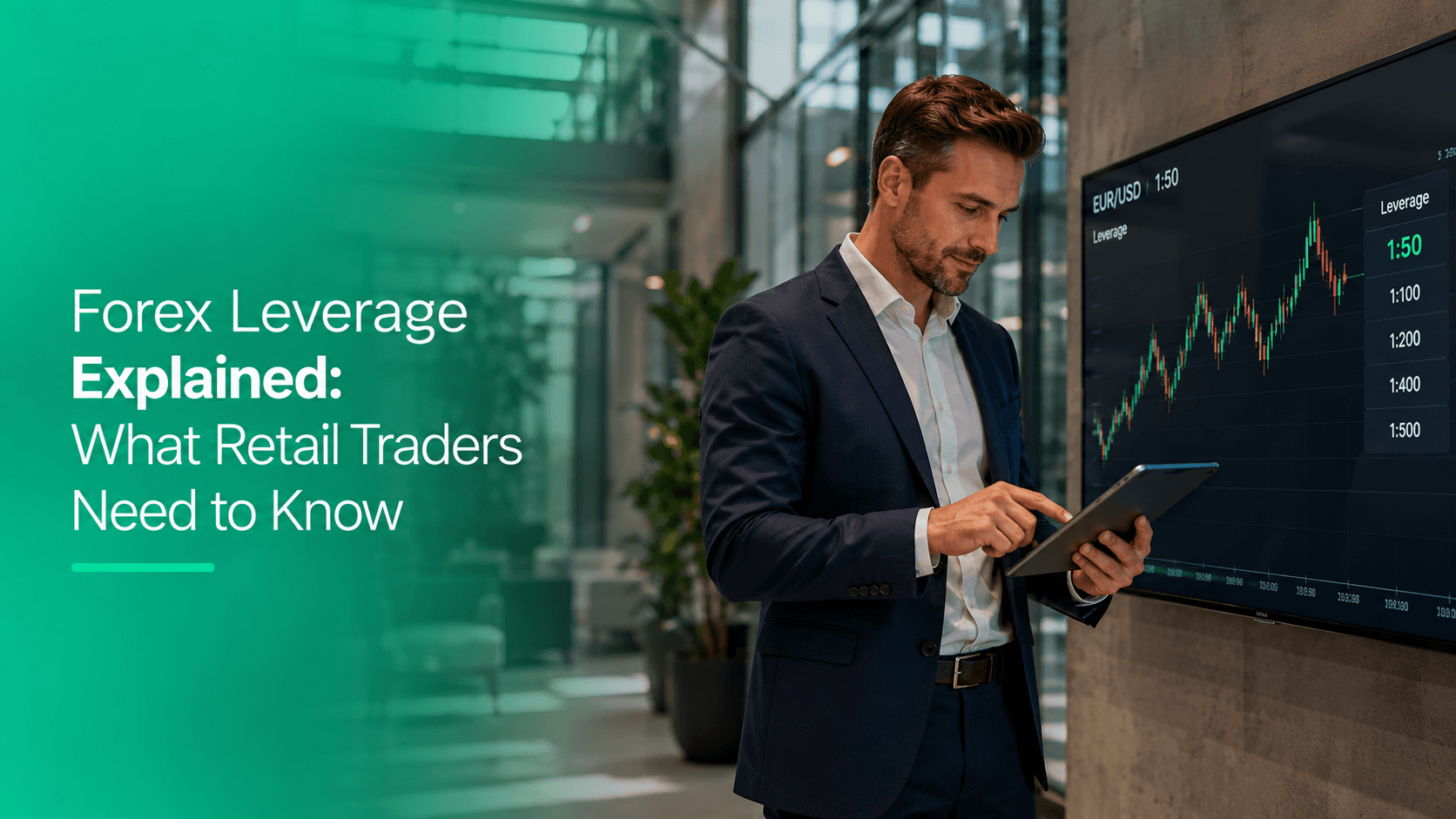
Forex leverage lets retail traders control a larger position with a smaller amount of capital. A trader using 30:1 leverage, for example, can control a $30,000 position with $1,000 in margin.
That sounds attractive, but leverage cuts both ways. It can increase returns when a trade moves in your favor, but it also increases losses when the market moves against you. For many retail traders, the real danger is not simply “high leverage.” It is using leverage without understanding margin, position size, stop-out rules, and how quickly losses can compound.
This guide explains how forex leverage works, why regulators limit it, and what traders should check before opening a leveraged forex account.
What Is Forex Leverage?
Forex leverage is the ability to trade a position larger than the cash balance in your account. The broker does not give you free money. Instead, it allows you to control a larger notional trade by setting aside part of your account as margin.
If your broker offers 30:1 leverage, the margin requirement is roughly 3.33% of the position size. If your broker offers 50:1 leverage, the margin requirement is 2%.
Here is a simple example:
| Leverage | Margin Required | Position Controlled With $1,000 |
|---|---|---|
| 10:1 | 10% | $10,000 |
| 20:1 | 5% | $20,000 |
| 30:1 | 3.33% | $30,000 |
| 50:1 | 2% | $50,000 |
| 100:1 | 1% | $100,000 |
The higher the leverage, the larger the position you can open with the same account balance. But that also means smaller price movements can have a larger effect on your equity.
Leverage vs Margin
Leverage and margin are connected, but they are not the same thing.
Leverage describes the ratio between your account funds and the position you can control. Margin is the amount of money the broker requires you to set aside to open and maintain the trade.
For example, if you open a $30,000 EUR/USD position with 30:1 leverage, the required margin is about $1,000. That $1,000 is not a fee. It is collateral for the open trade.
The trade’s profit or loss still moves based on the full $30,000 position, not only the $1,000 margin. This is why leverage can make a small account feel powerful while also making it fragile.
Why Forex Brokers Offer Leverage
Forex prices often move in small percentage increments compared with many individual stocks or crypto assets. Leverage allows traders to gain meaningful exposure to those smaller price movements.
For example, a 0.5% move in a currency pair may not sound large. But on a leveraged position, that move can represent a much larger percentage of the trader’s account.
Brokers also offer leverage because it makes trading more accessible. A trader does not need the full notional value of a currency position upfront. However, accessibility is not the same as safety. Easy access to large positions is exactly why leverage needs to be treated carefully.
How Leverage Magnifies Losses
Suppose a trader has a $1,000 account and opens a $30,000 position using 30:1 leverage.
If the trade moves 1% in the trader’s favor, the position gains about $300 before spreads, commission, and financing costs. That is a 30% return on the $1,000 account.
But if the trade moves 1% against the trader, the position loses about $300. That is a 30% account loss.
The currency pair only moved 1%, but the account moved 30%. That is the central lesson of leverage.
Leverage does not only increase opportunity. It increases the speed at which mistakes become expensive.
Retail Forex Leverage Limits by Region
Retail leverage limits vary by jurisdiction. Traders should always check the rules that apply to the legal entity opening their account, not just the broker’s brand name.
In the UK, the FCA’s permanent CFD restrictions require firms offering CFDs and CFD-like options to retail clients to limit leverage between 30:1 and 2:1 depending on the volatility of the underlying asset. The FCA also requires margin close-out protection and negative balance protection for retail CFD clients.
In the EU, ESMA-style CFD measures set leverage limits from 30:1 for major currency pairs down to 2:1 for cryptocurrencies, along with margin close-out rules, negative balance protection, and standardized risk warnings.
In Australia, ASIC extended its CFD product intervention order until 23 May 2027. ASIC states that the order includes leverage ratio limits ranging from 30:1 to 2:1, standardized margin close-out rules, negative balance protection, and restrictions on certain inducements.
In the United States, CFTC retail forex rules require minimum security deposits of 2% of notional value for major currency pairs and 5% for other currency pairs. In practical terms, that corresponds to maximum leverage of about 50:1 on major pairs and 20:1 on non-major pairs.
Typical retail limits look like this:
| Jurisdiction | Major FX Pairs | Non-Major FX Pairs |
|---|---|---|
| UK / FCA | 30:1 | Commonly 20:1 |
| EU / ESMA-style rules | 30:1 | 20:1 |
| Australia / ASIC | 30:1 | 20:1 |
| United States / CFTC framework | About 50:1 | About 20:1 |
If a broker advertises 500:1, 1000:1, or higher leverage to retail clients, check the jurisdiction carefully. Very high leverage is usually offered through offshore entities, where investor protections may be weaker.
Why Regulators Limit Leverage
Regulators limit leverage because many retail clients lose money trading CFDs and leveraged forex products.
The FCA says CFDs are complex, leveraged derivatives typically offered through online platforms, and its restrictions were designed to reduce harm to retail consumers. ASIC reported that after its CFD product intervention order took effect, retail client aggregate net losses fell sharply during the first six months of operation.
The point is not that every trader should use the regulatory maximum. The point is that regulators have seen enough retail losses to treat excessive leverage as a major risk factor.
Leverage limits are usually paired with other protections, such as:
- Margin close-out rules
- Negative balance protection
- Restrictions on trading incentives
- Standardized risk warnings
These protections help, but they do not make leveraged forex trading low-risk. Traders can still lose their full deposit.
High Leverage Does Not Mean Better Trading Conditions
Some traders assume a broker with higher leverage is better. That is not always true.
High leverage can be useful for certain advanced strategies, but it can also encourage oversized positions. A broker offering 1000:1 leverage may look flexible, yet the more important questions are regulation, execution quality, withdrawal reliability, spreads, commissions, and how the broker handles margin close-outs.
For most retail traders, the best broker is not the one offering the highest leverage. It is the one offering transparent conditions under a credible regulatory framework.
Broker comparison should focus on regulation, platforms, trading costs, and account conditions, not only the maximum leverage shown in broker rankings.
How Much Leverage Should Retail Traders Use?
The maximum leverage available is not the same as the leverage you should use.
A broker may allow 30:1 or 50:1, but you can choose to trade smaller positions. In practice, many disciplined traders use far less effective leverage than the account maximum.
Effective leverage measures the size of your open positions relative to your account equity. If you have a $2,000 account and open $20,000 in total forex exposure, your effective leverage is 10:1. If you open $60,000 in exposure, it is 30:1.
For beginners, lower effective leverage is usually safer because it leaves more room for normal market movement. A trade should not be so large that a small price move threatens the account.
Leverage, Stop Losses, and Position Size
A stop loss helps define trade risk, but it does not automatically make high leverage safe.
If your position is too large, even a normal stop-loss distance can risk too much of the account. For example, risking 2% of a $1,000 account means the planned loss should be about $20. If the position size is too large, a stop loss only 10 or 20 pips away could exceed that risk limit.
This is why position sizing matters more than the leverage number shown in the broker portal.
A practical process is:
- Decide how much of the account you are willing to risk on the trade.
- Choose the stop-loss distance based on the market structure.
- Calculate the position size that matches that risk.
- Check the required margin and remaining free margin.
- Avoid increasing trade size just because the broker allows it.
Leverage should support the trade plan. It should not define the trade plan.
Margin Calls and Stop-Outs
A margin call occurs when your account equity falls too close to the margin required to keep positions open. A stop-out occurs when the broker automatically closes one or more positions because the account no longer has enough equity to support them.
Different brokers use different margin call and stop-out levels, so traders should read the broker’s terms before depositing.
A margin close-out rule can reduce the risk of an account falling deeply negative, but it does not guarantee a good exit price. During fast markets, prices can gap or slip. This is why negative balance protection matters for retail traders where it is available.
If you trade with high leverage, margin calls can happen quickly. A position does not need to move very far against you before equity drops below the required threshold.
The Main Risks of Forex Leverage
Leverage affects more than account math. It changes trader behavior.
When position sizes are too large, traders often close winners too early, move stop losses, overreact to normal price movement, or revenge trade after a loss. The pressure comes from knowing that a small market move can have a large account impact.
The main risks include:
- Faster losses from small price movements
- Margin calls and forced liquidation
- Overtrading because positions feel cheap to open
- Larger slippage impact during volatile markets
- Emotional decision-making under pressure
- Increased risk when holding trades over news or weekends
These risks are manageable only when position size, stop loss, and free margin are planned before entering the trade.
What to Check Before Using Leverage With a Broker
Before opening a leveraged forex account, check the broker’s legal entity and regulatory status. A global broker may offer different leverage depending on whether your account is opened under a UK, EU, Australian, U.S., or offshore entity.
Also review the broker’s margin rules. Look for the margin call level, stop-out level, negative balance protection, contract specifications, and whether margin requirements can change during volatile conditions.
Broker pricing matters too. Higher leverage does not help if spreads are wide, commissions are unclear, or execution is poor. Market Maker, ECN, and STP broker models can also affect pricing and execution.
Final Takeaway
Forex leverage allows retail traders to control larger positions with smaller deposits, but it also magnifies losses. A 1% market move can have a much larger effect on a leveraged account, especially when position size is too aggressive.
Retail traders should focus less on the highest leverage a broker offers and more on effective leverage, position sizing, margin rules, regulation, and risk controls. The safest approach is to use leverage deliberately, not automatically.
A broker offering lower but well-regulated leverage may be a better choice than an offshore broker advertising extreme leverage with weaker protections.
FAQs
What is forex leverage?
Forex leverage allows traders to control a larger currency position with a smaller amount of margin. For example, 30:1 leverage allows $1,000 in margin to control a $30,000 position.
Is forex leverage risky?
Yes. Leverage magnifies both gains and losses. A small market move can create a large change in account equity when position size is too high.
What leverage is best for beginners?
Beginners usually benefit from lower effective leverage. The exact level depends on account size, strategy, stop-loss distance, and risk tolerance, but using the maximum available leverage is rarely necessary.
What is the difference between leverage and margin?
Leverage is the ratio of exposure to account funds. Margin is the collateral required to open and maintain a leveraged position.
Why do regulated brokers limit leverage?
Regulators limit leverage because excessive leverage can amplify retail trading losses. FCA, ESMA-style, ASIC, and CFTC frameworks all restrict retail leverage in different ways.
Is 500:1 leverage safe?
500:1 leverage allows very large positions relative to account size. It can lead to rapid losses and is usually offered through offshore entities. Retail traders should be cautious and check regulation carefully.

Related Posts

CMC Funded Is Titanium Sponsor of London Prop Trading Expo
CMC Funded, the new simulated evaluation programme from CMC Markets, is Titanium Sponsor of the London Prop Trading Expo on 23 and 24 October 2026. The programme also named Verichain as its first referral partner, with a $100,000 simulated evaluation that leads to an interview.

FundedTrading Heads to London Prop Trading Expo 2026 as Official Media Partner
FundedTrading joins the London Prop Trading Expo 2026 as Official Media Partner, with on-site coverage October 23–24 and 50% off tickets using code FT50.