Market Maker vs ECN vs STP Brokers: What Traders Need to Know

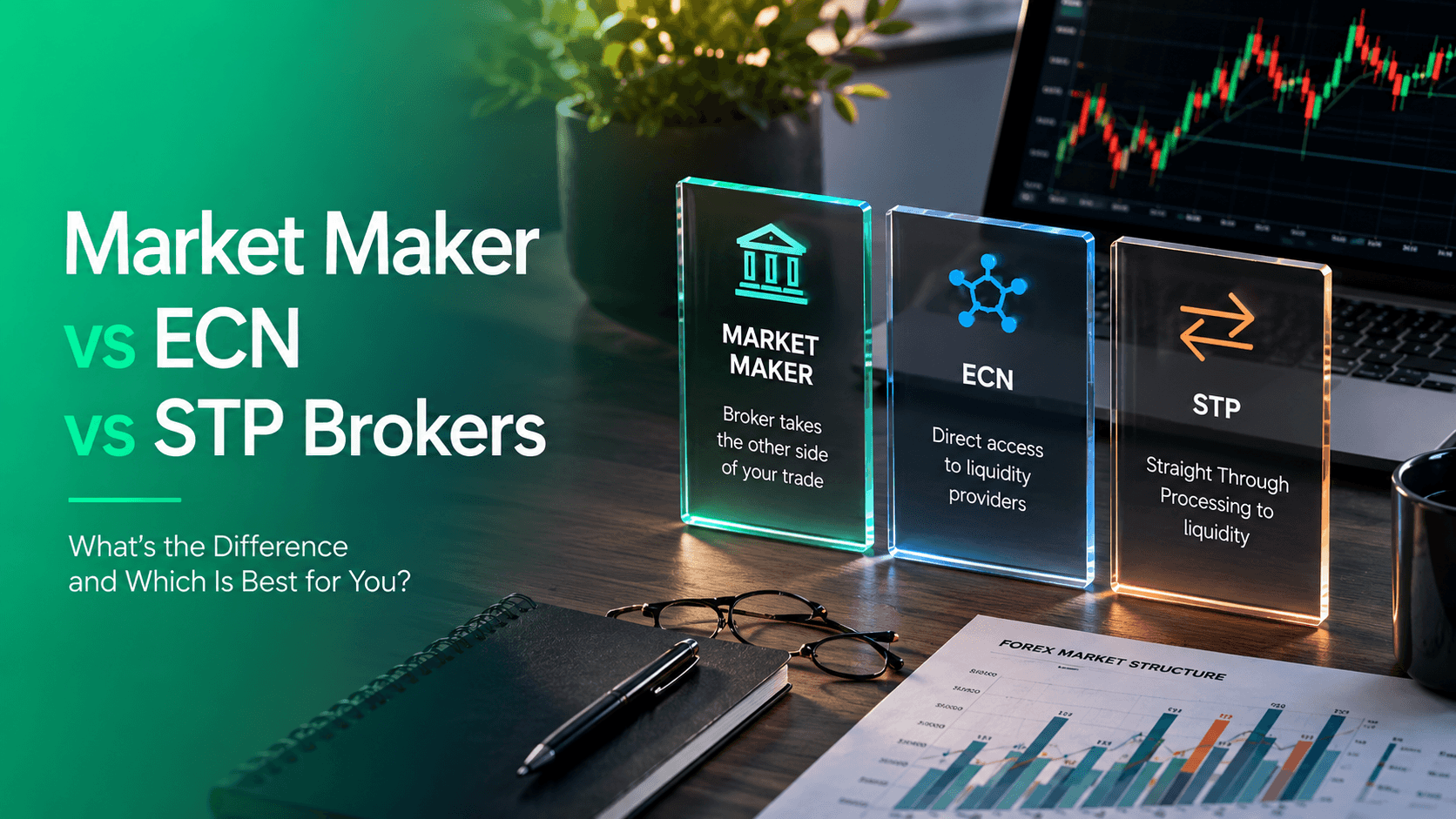
Choosing a forex broker is not only about spreads, platforms, or minimum deposits. Traders should also understand how the broker executes trades.
This is where the terms market maker, ECN, and STP usually appear.
Many brokers use these labels in their marketing. Some say they offer “true ECN” pricing. Others promote “no dealing desk” execution or “straight-through processing.” Some traders hear the term market maker and immediately think it is bad.
The reality is more balanced.
A market maker broker is not automatically a scam. An ECN broker is not automatically better. An STP broker is not automatically safer. What matters is how the broker handles execution, pricing, regulation, fees, and withdrawals.
This guide explains the difference between market maker, ECN, and STP brokers so traders can make a more informed choice.
Why Broker Execution Models Matter
When you place a forex trade, the broker has to process that order. The way it handles your order can affect spreads, commissions, slippage, execution speed, and possible conflicts of interest.
Some brokers act as the counterparty to client trades. Some route orders to liquidity providers. Some connect traders to a network of banks, institutions, or other market participants.
This does not always mean one model is good and the other is bad. Each model has benefits and trade-offs.
A beginner may prefer a simple broker with fixed or stable spreads. A scalper may care more about low spreads and fast execution. A high-volume trader may prefer commission-based pricing with deeper liquidity.
The key is to understand what you are paying for and how your order is handled.
What Is a Market Maker Broker?
A market maker broker provides its own buy and sell prices to clients. In many cases, the broker acts as the counterparty to the trade.
This means when a trader buys, the broker may take the opposite side. When a trader sells, the broker may be the buyer.
That sounds suspicious to many traders, but market making is a normal part of financial markets. A regulated market maker can provide liquidity, stable pricing, and easier trade execution for retail clients.
The concern is conflict of interest. If the broker profits when a client loses, traders may worry about unfair practices such as price manipulation, stop hunting, or delayed execution.
This is why regulation and transparency matter. A well-regulated market maker with clear pricing and strong oversight is very different from an unregulated broker that hides its rules.
How Market Maker Brokers Make Money
Market maker brokers usually earn through spreads. The spread is the difference between the bid and ask price.
For example, if EUR/USD has a bid price of 1.0850 and an ask price of 1.0852, the spread is 2 pips. The trader pays that difference when entering the market.
Some market makers offer fixed spreads. Others offer variable spreads that change based on market conditions.
Market makers may also manage risk internally. They may offset some client exposure with liquidity providers, keep some flow in-house, or use a mix of both. Traders usually do not see this process directly.
The main thing traders should check is whether the broker clearly explains its execution model, pricing, and risk disclosure.
Pros and Cons of Market Maker Brokers
Market maker brokers can be useful for beginners because pricing is often simple. Some offer low minimum deposits, easy platforms, and predictable trading conditions.
They may also provide strong liquidity for small retail orders. This can make order placement feel smoother for traders who are not trading large volume.
The downside is the potential conflict of interest. Since the broker may take the other side of client trades, traders need to trust that the broker is not abusing its position.
For this reason, market maker brokers should be judged carefully. Regulation, reputation, withdrawal history, and execution quality matter more than the label itself.
What Is an ECN Broker?
ECN stands for Electronic Communication Network.
An ECN broker connects traders to a network where prices can come from banks, liquidity providers, institutions, and sometimes other traders. Instead of setting its own prices in the same way as a market maker, the broker gives access to pricing from multiple participants.
ECN brokers often offer tighter spreads because prices come from competing sources. But traders usually pay a commission on each trade.
This model is popular with scalpers, active traders, and traders who want more direct market-style pricing.
That said, “ECN” is also one of the most overused terms in broker marketing. Some brokers claim to be ECN but do not clearly show how orders are routed or how pricing works.
How ECN Brokers Make Money
ECN brokers usually make money through commissions. Since spreads can be very low, sometimes close to zero on major pairs during liquid sessions, the broker charges a separate fee per trade.
This creates a clearer cost structure for some traders. Instead of paying only through a wider spread, the trader pays a raw or tight spread plus commission.
For active traders, this can be attractive. But low spreads do not always mean lower total cost. The commission must be included when comparing brokers.
Traders should calculate the full trading cost, especially if they trade frequently.
Pros and Cons of ECN Brokers
ECN brokers may offer tighter spreads, faster execution, and better pricing transparency. This can be useful for traders who rely on short-term strategies or trade during liquid market sessions.
The downside is that ECN accounts may require higher deposits, charge commissions, and have spreads that widen during volatile periods.
Execution can still include slippage. ECN does not mean every order will be filled at the exact price shown. During news events or low liquidity, prices can move quickly.
The main point is simple: ECN can be useful, but it is not magic. It still carries trading risk, execution risk, and broker selection risk.
What Is an STP Broker?
STP stands for Straight Through Processing.
An STP broker routes client orders directly to liquidity providers instead of manually dealing with the order through a traditional dealing desk. The broker may connect with banks, prime brokers, or other liquidity sources.
In simple terms, the broker passes the order through to another party for execution.
STP brokers usually make money through spread markups or commissions. For example, if the liquidity provider offers a very tight spread, the broker may add a small markup before showing the price to the client.
STP is often marketed as a no dealing desk model. But traders should still check the details because execution models can vary between brokers.
How STP Brokers Make Money
STP brokers may earn from a markup on spreads, a commission, or both.
A spread markup means the broker receives pricing from liquidity providers, then adds a small difference before offering it to traders. This can make the cost look simple because the trader only sees the final spread.
A commission-based STP account may show tighter spreads but charge a separate trading fee.
Neither method is automatically bad. The question is whether the broker is transparent about it.
If the broker claims zero commission and ultra-low spreads but does not explain how it earns money, traders should look closer.
Pros and Cons of STP Brokers
STP brokers can offer a good middle ground between market maker and ECN models. They may provide direct routing, variable spreads, and less dealing desk involvement.
They can be suitable for traders who want market-based pricing but do not need a full ECN setup.
The weakness is that the STP label can be vague. Different brokers may use different liquidity providers, markups, execution rules, and order routing methods.
Some brokers may call themselves STP mainly for marketing. That is why traders should not rely on the label alone.
Market Maker vs ECN vs STP: Quick Comparison
| Broker Type | How It Works | Common Fee Style | Main Benefit | Main Risk |
|---|---|---|---|---|
| Market Maker | Broker may act as counterparty to client trades | Spread-based pricing | Simple pricing and easy access for retail traders | Potential conflict of interest |
| ECN | Broker connects traders to an electronic pricing network | Tight spread plus commission | Lower spreads and market-style pricing | Commission costs and variable execution |
| STP | Broker routes orders to liquidity providers | Spread markup, commission, or both | No dealing desk style routing | Model can be vague or used as marketing |
This comparison is useful as a starting point. But the broker’s regulation, terms, execution policy, and withdrawal record matter more than the label.
Is a Market Maker Broker Bad?
No, a market maker broker is not automatically bad.
Some of the most established retail brokers operate as market makers or use market-making in part of their execution model. This can help provide liquidity to retail traders and support smaller account sizes.
The problem starts when a broker is unregulated, hides its dealing model, manipulates prices, delays withdrawals, or makes unrealistic profit claims.
A regulated market maker can be safer than an unregulated broker claiming to be ECN.
This is why traders should avoid judging brokers by labels alone. A broker’s legal status, conduct, pricing, and withdrawal practices matter more.
Is an ECN Broker Always Better?
No, an ECN broker is not always better.
ECN pricing can be useful, especially for active traders. But it may not be the best choice for everyone. Beginners may find commission structures confusing. Spreads can widen during volatile periods. Minimum deposits may be higher.
Some brokers also use the ECN label loosely. A broker can claim to offer ECN-style execution without giving traders enough information to verify how orders are handled.
If a broker says it is ECN, check the full cost, execution policy, liquidity details, account terms, and regulation.
Is an STP Broker Safer?
STP brokers can be good, but STP does not automatically mean safe.
The broker may still apply markups, route trades to selected liquidity providers, or operate under weak regulation. The quality of execution depends on the broker’s relationships, systems, risk management, and transparency.
STP is a useful term, but it should not replace due diligence.
A trader should still ask the same questions: Who regulates the broker? How does the broker make money? What happens during volatile markets? Are withdrawals reliable? Does the company clearly explain its execution model?
Dealing Desk vs No Dealing Desk
Market maker brokers are often called dealing desk brokers because they may handle pricing and execution internally.
ECN and STP brokers are usually described as no dealing desk brokers because orders are routed externally or connected to broader liquidity.
This distinction is useful, but it can be oversimplified.
Some brokers use hybrid models. They may process some orders internally and route others externally depending on trade size, client profile, market conditions, or risk exposure.
This is why traders should read the broker’s execution policy instead of relying only on marketing terms.
Spreads, Commissions, and Real Trading Costs
The cheapest-looking broker is not always the cheapest broker.
A market maker may offer wider spreads but no commission. An ECN broker may offer lower spreads but charge commission. An STP broker may add a markup to liquidity provider pricing.
To compare brokers fairly, traders should look at the all-in cost.
For example, if one account has a 0.2 pip spread plus commission and another account has a 1.2 pip spread with no commission, the better deal depends on the commission size, trade volume, and pairs traded.
This matters more for scalpers and active traders because small cost differences can add up quickly.
Slippage and Requotes
Execution quality is not only about the broker type.
Slippage happens when an order is filled at a different price from the one expected. It can be positive or negative. It often appears during fast market movement, major news, or low liquidity.
Requotes happen when the broker cannot fill the order at the requested price and offers a new price instead. This is more common with certain execution setups.
A broker should explain how it handles slippage, requotes, stop orders, and market execution. If this information is missing or vague, traders should be careful.
A good trading experience depends on clear pricing, stable execution, and honest order handling.
Red Flags to Watch
Broker model labels can be used as marketing. Traders should watch for signs that the broker is using terms like ECN, STP, or no dealing desk without real transparency.
Here are the main red flags:
- The broker claims “true ECN” but does not explain commission, liquidity, or execution
- The broker promises zero spread, zero commission, and guaranteed execution without explaining how it earns money
- The broker is not listed on the regulator’s official register
- The broker hides its legal company name or registered address
- The broker promises guaranteed profit
- Withdrawals are delayed or require extra fees
- The broker pushes bonuses with unclear trading conditions
- Reviews mention repeated price manipulation or withdrawal issues
This is the only checklist traders need before taking broker claims seriously.
How to Choose Between Market Maker, ECN, and STP Brokers
The best broker type depends on your trading style.
If you are a beginner, a simple and well-regulated broker with clear spreads, strong support, and reliable withdrawals may be more useful than chasing the lowest possible spread.
If you scalp or trade frequently, ECN or STP pricing may be more suitable because spreads and execution costs matter more. But you still need to calculate commission and check execution quality.
If you hold trades for days or weeks, spreads may matter less than swap fees, platform stability, and account rules.
The broker model matters, but it should not be the only decision factor. Regulation, fees, platform quality, execution policy, customer support, and withdrawal reliability should come first.
Questions to Ask Before Opening an Account
Before choosing a broker, ask these questions:
- Does the broker clearly explain whether it is market maker, ECN, STP, or hybrid?
- Is the broker regulated by a real financial authority?
- Can the broker be verified through the official regulator website?
- How does the broker make money?
- Does the account charge spreads, commissions, or both?
- What happens during high volatility?
- How are withdrawals processed?
- Does the broker have repeated complaints about execution or withdrawals?
If the answers are unclear, keep looking.
Final Thoughts
Market maker, ECN, and STP brokers all handle trades differently.
A market maker may take the other side of client trades and earn through spreads. An ECN broker connects traders to an electronic network and often charges commission. An STP broker routes orders to liquidity providers and may earn through markups or commissions.
None of these models is automatically the best. None is automatically safe either.
The smarter approach is to look beyond the label. Check regulation, execution policy, trading costs, platform quality, withdrawal rules, and real user feedback. A transparent broker should make these details easy to understand.
For traders, the goal is not to find the broker with the best marketing term. The goal is to find a broker that is regulated, fair, reliable, and suitable for the way you trade.
FAQs About Market Maker, ECN, and STP Brokers
What is the difference between market maker, ECN, and STP brokers?
A market maker may act as the counterparty to client trades. An ECN broker connects traders to an electronic pricing network. An STP broker routes orders to liquidity providers.
Are market maker brokers bad?
No. A market maker broker is not automatically bad. A regulated market maker with clear pricing and fair withdrawal practices can be suitable for many retail traders.
Are ECN brokers better than market makers?
Not always. ECN brokers may offer tighter spreads, but they often charge commissions. The better option depends on the trader’s strategy, account size, trade frequency, and cost structure.
What does STP mean in forex?
STP means Straight Through Processing. It refers to a broker model where client orders are routed to liquidity providers rather than handled manually through a dealing desk.
Can a broker be both STP and ECN?
Yes. Some brokers use hybrid models or offer different execution types across different accounts. Traders should read the broker’s execution policy instead of relying only on marketing terms.
How do I know if a broker is really ECN?
Check the broker’s execution policy, commission structure, liquidity information, spreads, and regulation. Be careful if a broker claims ECN execution but gives no clear details.

Related Posts

CMC Funded Is Titanium Sponsor of London Prop Trading Expo
CMC Funded, the new simulated evaluation programme from CMC Markets, is Titanium Sponsor of the London Prop Trading Expo on 23 and 24 October 2026. The programme also named Verichain as its first referral partner, with a $100,000 simulated evaluation that leads to an interview.

FundedTrading Heads to London Prop Trading Expo 2026 as Official Media Partner
FundedTrading joins the London Prop Trading Expo 2026 as Official Media Partner, with on-site coverage October 23–24 and 50% off tickets using code FT50.