How Much Money Do You Need to Start Trading?

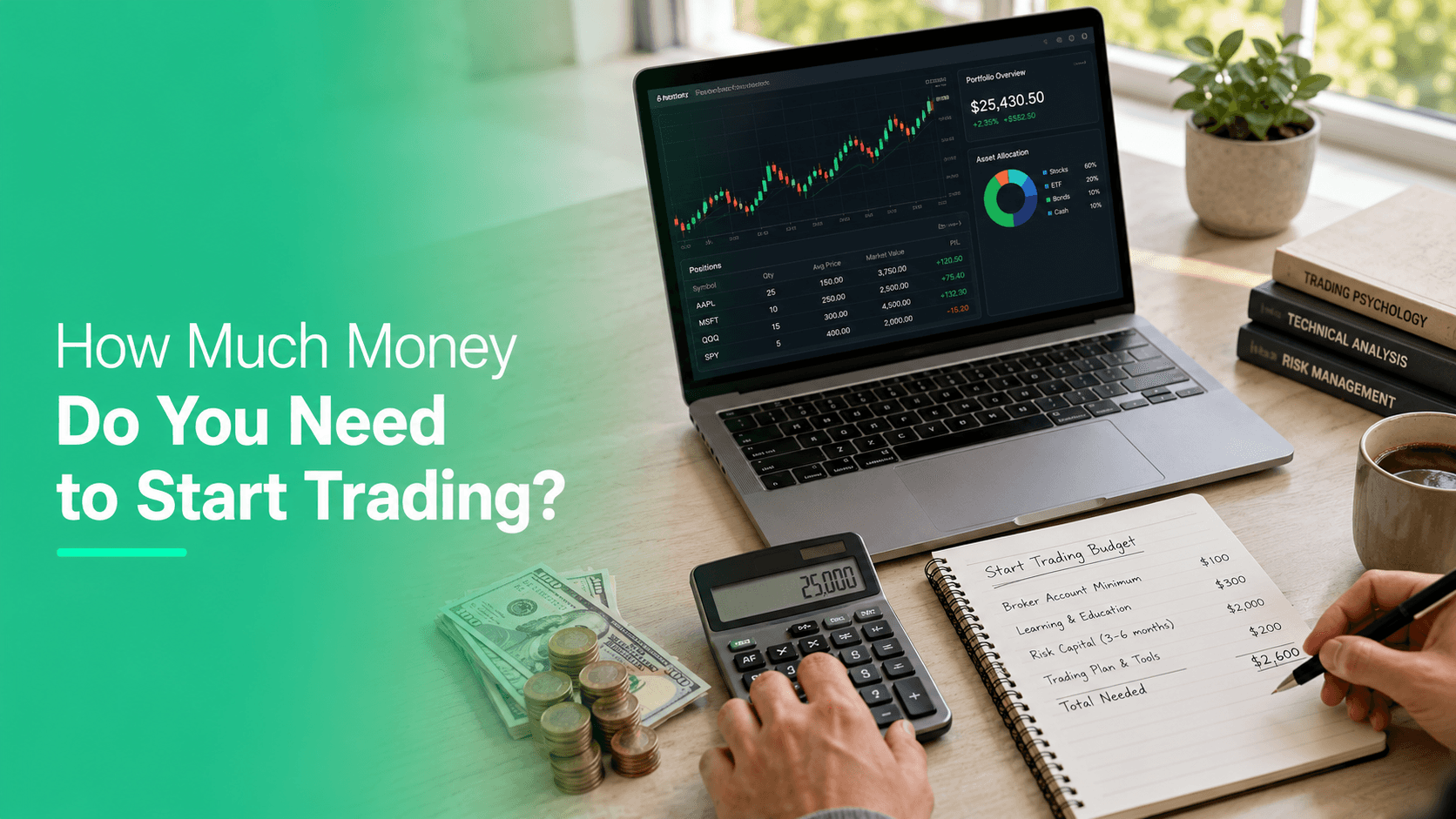
Most forex brokers will open an account for about 50 units of your account currency, and some accept less than that by bank transfer. That is the price of getting in, not the amount you need to trade. Work backwards from your stop loss instead and the realistic figure is closer to 300, because the floor is set by your risk per trade rather than by the broker's sign-up threshold.
The distance between those two numbers is where most new accounts die.
Why Is the Advertised Minimum Deposit Not the Number You Need?
The minimum deposit is a sign-up threshold. It tells you when a broker will accept you as a client. It says nothing about whether the account can survive a normal losing week.
It also moves around more than the headline figure suggests. It changes by account tier, by the entity that holds your account, and sometimes by how you pay. FXCM sets the minimum for a new individual account at 50 units of the account base currency, and states there is no minimum at all on deposits sent by bank wire, so the same broker gives two different answers depending on how the money arrives.
That detail sits in the funding terms, not on the sign-up page, which is why FXCM's account and deposit conditions are worth reading before you register rather than after.
Tiering is the other thing that catches people out. Vantage's account tiers each carry their own minimum, and the entry account and the accounts aimed at high-volume traders are not close to each other.
Traders often compare the lowest advertised number at one broker against a mid-tier account at another and conclude the first is cheaper to start with. Read across the tiers instead, since minimums and trading conditions move together. That is covered in full in how forex account types differ on spreads, commissions and minimums.
So the first job is not comparing minimums. It is checking which minimum applies to you, in your country, on the account you actually intend to open. That check belongs alongside the other conditions you weigh when choosing a forex broker to deposit with.
How Much Margin Does One Small Trade Actually Need?
The smallest position most brokers allow is 0.01 lots, called a micro lot. That is 1,000 units of the base currency, so a 0.01 lot EUR/USD trade puts 1,000 euros of exposure on the market.
You do not fund all of that. You fund the margin, and the leverage available to you decides how much margin that is.
Under FCA rules, retail leverage on major currency pairs is capped at 30:1, with tighter caps on everything else, down to 2:1. At 30:1, margin on that 1,000-euro position is one thirtieth, or roughly 33 euros.
Which makes 50 sound like plenty. It is not, and the reason is the close-out rule sitting behind the cap. If margin and exposure are new to you, how CFD trading works, including margin covers the mechanics.
What Happens If You Deposit Only the Minimum?
The FCA requires brokers to start closing your positions once your account equity falls to 50% of the margin your open positions need. Two accounts funded with the same 50 can sit in completely different danger depending on the leverage that applies to them.
At 30:1, a 50 account supports about 1,500 of exposure, so 0.015 lots. Each pip is worth about 15 cents. Required margin is 50, close-out triggers at 25, which leaves roughly 165 pips of room before the broker starts shutting you down. Survivable.
At 500:1, the same 50 supports 25,000 of exposure. Each pip is now worth about 2.50. Required margin is 50, close-out still triggers at 25, and 25 divided by 2.50 is 10. Ten pips. EUR/USD covers 10 pips in the time it takes to read this paragraph.
High leverage does not make a small deposit go further. It lets you open a position large enough to be closed out by noise, which is the opposite.
So What Is a Realistic Starting Amount?
Work back from the loss you are willing to take on one trade.
A common approach is to risk about 1% of the account per trade. On EUR/USD, one pip on a 0.01 lot position is about 10 cents. A 30-pip stop loss therefore risks about 3. For 3 to be 1% of your account, the account needs to be about 300.
Widen the stop and the number moves with it. A 50-pip stop on the same position risks 5, which puts the account at 500. Trade a pair with a larger pip value or a wider normal range and it climbs again.
That is the whole calculation. It has nothing to do with the broker's minimum and everything to do with the smallest position size the account allows, because that sets the smallest loss you can take.
If the account only trades in 0.01 lots and your strategy needs a 60-pip stop, the arithmetic will not let you start with 50 and manage risk properly at the same time.
Does Depositing More Make You Safer?
It buys room, not skill.
The FCA makes brokers publish the percentage of their retail client accounts that lose money, and that number sits on the broker's own website. Go and read it for any broker you are considering before you decide how much to send.
A larger deposit lengthens how long you last while you find out which side of that percentage you are on. It does not change the side.
What Should You Check Before Sending Money?
Run these checks before you fund anything:
- The minimum for your country and entity, not the global figure on the homepage
- The smallest position size the account allows, in lots
- The maximum leverage that applies to your account, which depends on your regulator, not your preference
- The minimum withdrawal amount, which is sometimes higher than the minimum deposit
- Whether the account charges an inactivity fee
- How long verification and withdrawals actually take in practice
The fee side of that list is worth going through properly, since the full range of forex broker fees reaches further than most traders expect.
The last item is where other traders are more useful than the broker. Verification and payout delays show up in trader reports long before they appear in the terms, which is what makes pages like the verification and payout reports in ABans Global's trader reviews worth reading first.
If you only have 50 to put in, put it in a demo account and trade the size you would trade for real. The account that survives that is the one worth funding.

Related Posts

CMC Funded Is Titanium Sponsor of London Prop Trading Expo
CMC Funded, the new simulated evaluation programme from CMC Markets, is Titanium Sponsor of the London Prop Trading Expo on 23 and 24 October 2026. The programme also named Verichain as its first referral partner, with a $100,000 simulated evaluation that leads to an interview.

FundedTrading Heads to London Prop Trading Expo 2026 as Official Media Partner
FundedTrading joins the London Prop Trading Expo 2026 as Official Media Partner, with on-site coverage October 23–24 and 50% off tickets using code FT50.