What Is a Dealing Desk Broker?

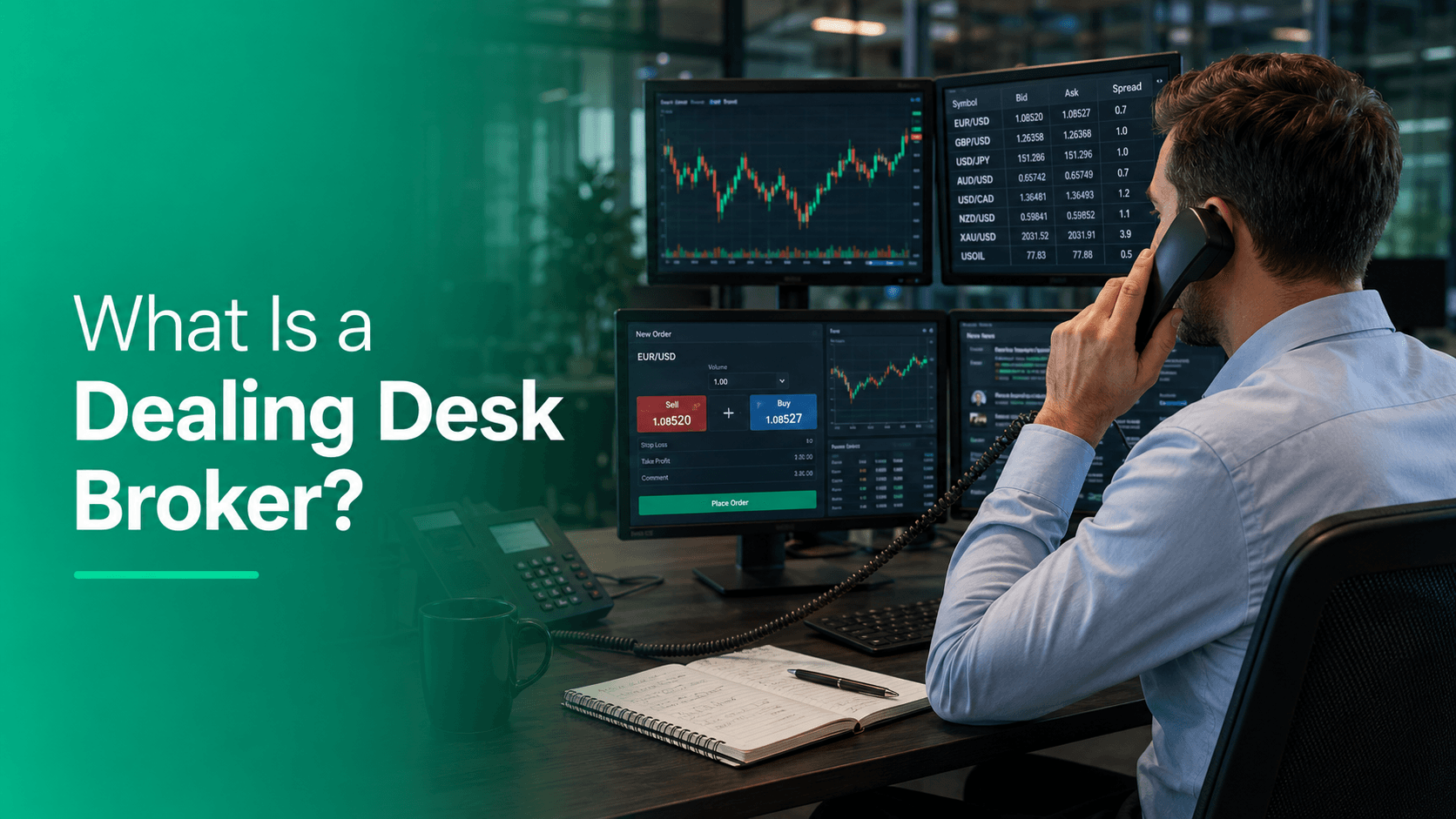
A dealing desk broker is a broker that can take the other side of a client’s trade, manage orders internally, and quote its own bid and ask prices to clients. In retail forex and CFD trading, dealing desk brokers are commonly associated with the market maker model.
This does not automatically mean the broker is bad. A well-regulated dealing desk broker can offer stable pricing, simple account conditions, fixed or predictable spreads, and reliable execution for many retail traders. The issue is transparency. Traders need to understand how orders are handled, how the broker makes money, and whether there is a conflict of interest between the broker and the client.
In simple terms, a dealing desk broker may be your counterparty. That makes regulation, execution policy, pricing, and withdrawal reliability especially important.
What Does “Dealing Desk” Mean?
A dealing desk is the part of a broker’s operation that manages client orders, pricing, and risk exposure. Instead of sending every trade directly to external liquidity providers, a dealing desk broker may internalize trades.
If a trader buys EUR/USD, the broker may take the opposite side of that trade. If the trader loses, the broker may profit from that specific position. If the trader wins, the broker may lose on that position unless it has hedged the risk elsewhere.
In practice, brokers manage this risk in different ways. Some internalize smaller client flow. Some hedge larger or riskier positions with banks or liquidity providers. Some use a hybrid model depending on client behavior, market conditions, trade size, and internal risk limits.
This is why “dealing desk” should not be used as a lazy insult. It describes an execution and risk-management model, not automatically a scam.
Is a Dealing Desk Broker the Same as a Market Maker?
Usually, yes. In retail forex, a dealing desk broker is often called a market maker because it creates a market for its clients by quoting buy and sell prices.
A market maker broker can provide liquidity when a trader wants to enter or exit. The broker earns money through spreads, markups, client losses, or a mix of pricing and risk-management activity.
The National Futures Association defines a forex dealer in part as a person or firm that makes a market in forex or regularly enters into forex transactions with counterparties for its own account. The CFTC’s retail forex framework also treats retail forex counterparties and intermediaries as regulated participants that must follow disclosure, reporting, and business conduct rules.
For traders, the key point is not the label. The key point is whether the broker clearly explains its execution model and is supervised by a credible regulator.
How a Dealing Desk Broker Handles Orders
When you place a trade with a dealing desk broker, the broker does not necessarily send that order straight into the wider interbank market. It may handle the order internally.
A simplified flow looks like this:
- You place a buy or sell order on the platform.
- The broker quotes the price available to you.
- The broker fills the order internally or offsets the risk externally.
- Your profit or loss is calculated against the broker’s quoted price.
- The broker manages its net exposure across many clients.
This internalization can make execution fast and simple in normal market conditions. But it also means traders should pay attention to spreads, slippage, requotes, stop-loss handling, and whether the broker can adjust execution under certain conditions.
A serious broker should explain these details in its order execution policy or trading terms.
Dealing Desk vs No-Dealing-Desk Brokers
The main difference is how orders are routed and how the broker manages trade exposure.
A dealing desk broker may act as the counterparty and manage trades internally. A no-dealing-desk broker usually routes orders to external liquidity providers, although the exact setup depends on whether the broker uses STP, ECN, or another agency-style model.
| Broker Model | How Orders Are Usually Handled | Common Cost Structure |
|---|---|---|
| Dealing desk / market maker | Broker may internalize trades and act as counterparty | Spread markup, sometimes fixed spreads |
| STP | Orders routed to liquidity providers | Variable spreads, possible markup |
| ECN-style | Orders matched through a network or liquidity pool | Raw spreads plus commission |
| Hybrid | Mix of internalization and external hedging | Depends on account type and client flow |
The categories are useful, but real brokers are not always cleanly separated. Many brokers use hybrid execution. A broker might advertise STP or ECN-style pricing on one account type while using a different model elsewhere.
These differences matter because Market Maker, ECN, and STP brokers can handle pricing, routing, and conflict of interest in different ways.
Why Traders Worry About Dealing Desk Brokers
The main concern is conflict of interest.
If a broker is the counterparty to your trade, your loss can be the broker’s gain on that position. That creates an obvious concern: will the broker still treat execution fairly?
Regulated brokers are expected to manage conflicts of interest and treat customers fairly. The FCA’s CFD guidance covers expectations for firms offering CFDs, including rolling spot forex, while ESMA’s CFD intervention measures were designed to address retail investor harm from complex leveraged products.
Still, traders should not rely on trust alone. They should check the broker’s regulation, execution policy, pricing history, complaint patterns, and withdrawal behavior.
A dealing desk model becomes more concerning when the broker is unregulated, hides its legal entity, promises guaranteed profits, or refuses to explain how orders are executed.
Are Dealing Desk Brokers Bad?
No, not automatically.
A dealing desk broker can be suitable for some retail traders, especially beginners who want simple pricing, smaller trade sizes, and a familiar platform. Some market makers are heavily regulated and operate under clear conduct rules.
The problem is not the existence of a dealing desk. The problem is poor transparency, weak regulation, unfair execution, or abusive sales behavior.
A good dealing desk broker should be clear about:
- Whether it acts as principal or agent
- How spreads are set
- Whether prices can be requoted
- How slippage is handled
- Whether stop losses are guaranteed or not
- When spreads may widen
- How conflicts of interest are managed
If this information is hard to find, that is a warning sign.
Advantages of a Dealing Desk Broker
A dealing desk broker can offer practical benefits, especially for newer traders.
Pricing may be simpler because the broker often builds its fee into the spread rather than charging a separate commission. Some dealing desk brokers also offer fixed spreads under normal conditions, which can make trading costs easier to understand.
Execution can also feel smoother for small orders because the broker can fill trades internally rather than routing every order externally. This may be useful for traders who prioritize convenience over raw institutional-style pricing.
The main advantages are:
- Simple spread-based pricing
- Smaller minimum deposits in many cases
- Familiar retail trading platforms
- Possible fixed or more predictable spreads
- Internal liquidity for smaller trade sizes
These benefits are most valuable when the broker is properly regulated and transparent about execution.
Disadvantages of a Dealing Desk Broker
The disadvantages come from the same structure that creates the benefits.
Because the broker may be the counterparty, traders need to think carefully about conflicts of interest. Spreads may be wider than raw-spread accounts. Some brokers may use requotes, reject orders during fast markets, or widen spreads around news and rollover.
This does not mean every dealing desk broker behaves unfairly. But it does mean traders should read the execution terms before depositing.
The main drawbacks are:
- Potential conflict of interest
- Spread markups may be higher
- Less direct market access
- Possible requotes or order restrictions
- Execution quality depends heavily on broker conduct
- Weaker protection if the broker is offshore or unregulated
For active scalpers, news traders, and high-volume traders, these drawbacks can matter more than they would for a casual or lower-frequency trader.
Dealing Desk Broker vs ECN Broker
Many traders compare dealing desk brokers with ECN brokers because the models feel very different.
An ECN-style broker usually promotes raw spreads, commission-based pricing, and access to multiple liquidity providers. A dealing desk broker usually promotes simple pricing, fixed or marked-up spreads, and easier account conditions.
Neither model is automatically best.
A scalper may prefer ECN-style pricing if execution is strong and commission is competitive. A beginner may prefer a dealing desk broker if the costs are simple and the broker is well-regulated. A swing trader may care less about the execution label and more about swaps, platform reliability, and withdrawal quality.
The question is not “dealing desk or ECN?” The better question is: which broker gives transparent conditions that fit your trading style?
How Dealing Desk Brokers Make Money
A dealing desk broker can earn revenue in several ways.
The most common method is the spread. The broker quotes a buy price and sell price, and the difference between them becomes part of the trading cost. Some brokers may also charge commissions, swap fees, inactivity fees, currency conversion fees, or withdrawal fees.
If the broker internalizes client trades, it may also profit when clients lose, depending on whether it hedges the trade. This is the source of the conflict-of-interest concern.
That is why a trader should look beyond “zero commission.” A broker with no commission still earns somewhere, usually through spreads, markups, financing, or internal risk management.
Broker cost analysis should include spreads, commissions, swap fees, and any account charges that affect the all-in trading cost.
What to Check Before Using a Dealing Desk Broker
Before depositing with a dealing desk broker, check the broker’s legal entity and regulator first. Do not rely only on the brand name on the homepage. Broker groups can operate through several entities, and the protections available to you may depend on which company opens your account.
Then read the execution policy. Look for clear language on whether the broker acts as principal, agent, or both. Check whether orders are filled at market, whether requotes are possible, how slippage works, and what happens during volatile conditions.
You should also test the broker carefully. Use a demo account to understand the platform, then consider a small live deposit and small withdrawal before committing larger funds. A broker’s real quality often becomes clearer after you test execution, support, and withdrawals with actual money.
Red Flags in Dealing Desk Brokers
A dealing desk model deserves extra caution when the broker is vague or aggressive. Watch for these warning signs:
- The broker hides its legal company name
- The broker cannot be verified on the regulator’s website
- The broker promises guaranteed profit
- The broker claims “no risk” trading
- Spreads and execution rules are unclear
- Withdrawals require surprise fees or extra deposits
- The account manager pressures you to trade larger
- The broker advertises extreme leverage with weak regulation
- Customer complaints repeatedly mention price manipulation or blocked withdrawals
One red flag does not always prove a broker is unsafe. Several together should make you stop before depositing.
Several of these warning signs overlap with broker regulation checks, especially when the legal entity, regulator, or client protections are unclear.
Who Might Use a Dealing Desk Broker?
A dealing desk broker may suit a trader who wants simple pricing, a standard account, smaller minimum deposits, and a platform that is easy to understand.
It may be less suitable for traders who need ultra-tight spreads, high-speed execution, very low latency, or institutional-style order routing. Scalpers and high-volume traders usually need to pay closer attention to execution data, commission, and slippage.
The best fit depends on the trader’s strategy, not just the broker label.
A beginner should focus on regulation, clarity, and risk controls. An active trader should focus more heavily on all-in trading cost and execution consistency. A swing trader should check swaps, rollover costs, and platform stability.
Final Takeaway
A dealing desk broker is a broker that can internalize client trades and act as the counterparty. This model is often associated with market maker brokers.
That does not make dealing desk brokers automatically bad. Some are regulated, transparent, and suitable for retail traders. But the model does create potential conflicts of interest, so traders should be careful with execution policy, pricing, regulation, and withdrawal history.
The safest approach is not to reject every dealing desk broker. It is to understand how the broker handles orders, verify its regulation, and make sure its trading conditions match your strategy before depositing.
FAQs
What is a dealing desk broker?
A dealing desk broker is a broker that may process trades internally and act as the counterparty to client orders. In retail forex, this model is commonly linked with market maker brokers.
Is a dealing desk broker the same as a market maker?
Usually, yes. A market maker broker quotes buy and sell prices to clients and may take the opposite side of client trades.
Are dealing desk brokers bad?
Not necessarily. A regulated dealing desk broker can be legitimate and suitable for many traders. The main concerns are conflict of interest, pricing transparency, and execution quality.
How does a dealing desk broker make money?
A dealing desk broker may earn from spreads, markups, commissions, swap fees, and internalized client flow. The exact model should be explained in the broker’s trading terms.
Is an ECN broker better than a dealing desk broker?
Not always. ECN-style brokers may offer raw spreads and commission-based pricing, but trading costs and execution quality still vary. The better broker is the one with transparent conditions, credible regulation, and pricing that fits your strategy.
How can I tell if a broker has a dealing desk?
Read the broker’s execution policy, client agreement, and account-type pages. Look for terms such as market maker, principal, counterparty, dealing desk, internalization, STP, ECN, or agency execution.

Related Posts

CMC Funded Is Titanium Sponsor of London Prop Trading Expo
CMC Funded, the new simulated evaluation programme from CMC Markets, is Titanium Sponsor of the London Prop Trading Expo on 23 and 24 October 2026. The programme also named Verichain as its first referral partner, with a $100,000 simulated evaluation that leads to an interview.

FundedTrading Heads to London Prop Trading Expo 2026 as Official Media Partner
FundedTrading joins the London Prop Trading Expo 2026 as Official Media Partner, with on-site coverage October 23–24 and 50% off tickets using code FT50.